
What to expect
What actually happens, start to finish
Five steps, and most of the work is the part you never see.
-
01
10 minutes
The call
We establish the purpose first, because it fixes the effective date and everything downstream. If a comparative market analysis would serve you better than an appraisal, you hear that here rather than after you have paid for one.
-
02
Same day
Fee and scope, in writing
Before anything is scheduled. The engagement states the intended use, who may rely on the report, the effective date, and the fee. Nothing about the fee is contingent on the value reached.
-
03
45–90 minutes
The inspection
Every room, including utility spaces and wherever the mechanical equipment sits. Exterior, lot, outbuildings. Measurements taken from the outside. You do not need to be present for all of it, but somebody has to provide access.
-
04
Several days
Research and analysis
Comparable sales pulled for the effective date, not for today. Adjustments developed and supported. This is most of the work and none of it is visible to you.
-
05
On delivery
The report
A written report, delivered digitally, with the value conclusion, the sales relied on, the adjustments explained, any extraordinary assumptions disclosed, and a signed USPAP certification. Sent to whoever the engagement names.
What the fee covers
Quoted on request is the flat fee for a single-family residence, whatever its size. It covers the inspection and measurement, the research and comparable analysis, the written report, and delivery to counsel or an accountant on your written instruction.
What sits outside it is work that genuinely scales: commercial property, two-to-four family, acreage and multi-parcel holdings, and retrospective dates far enough back that the research materially lengthens. Those are quoted individually, in writing, before anything begins. Full pricing.
What we cannot do
An appraisal is not a home inspection. It is not an environmental assessment, a survey, or a structural report. An appraiser observes what is visible and reports it, and is not qualified to determine the extent of a defect or what it would cost to put right.
Nor can an appraiser take a fee contingent on the value reached, agree a number in advance, or act as both appraiser and agent on the same property. Those are not house rules. They are the reason the report is worth anything to the person you need to convince.
What the report looks like
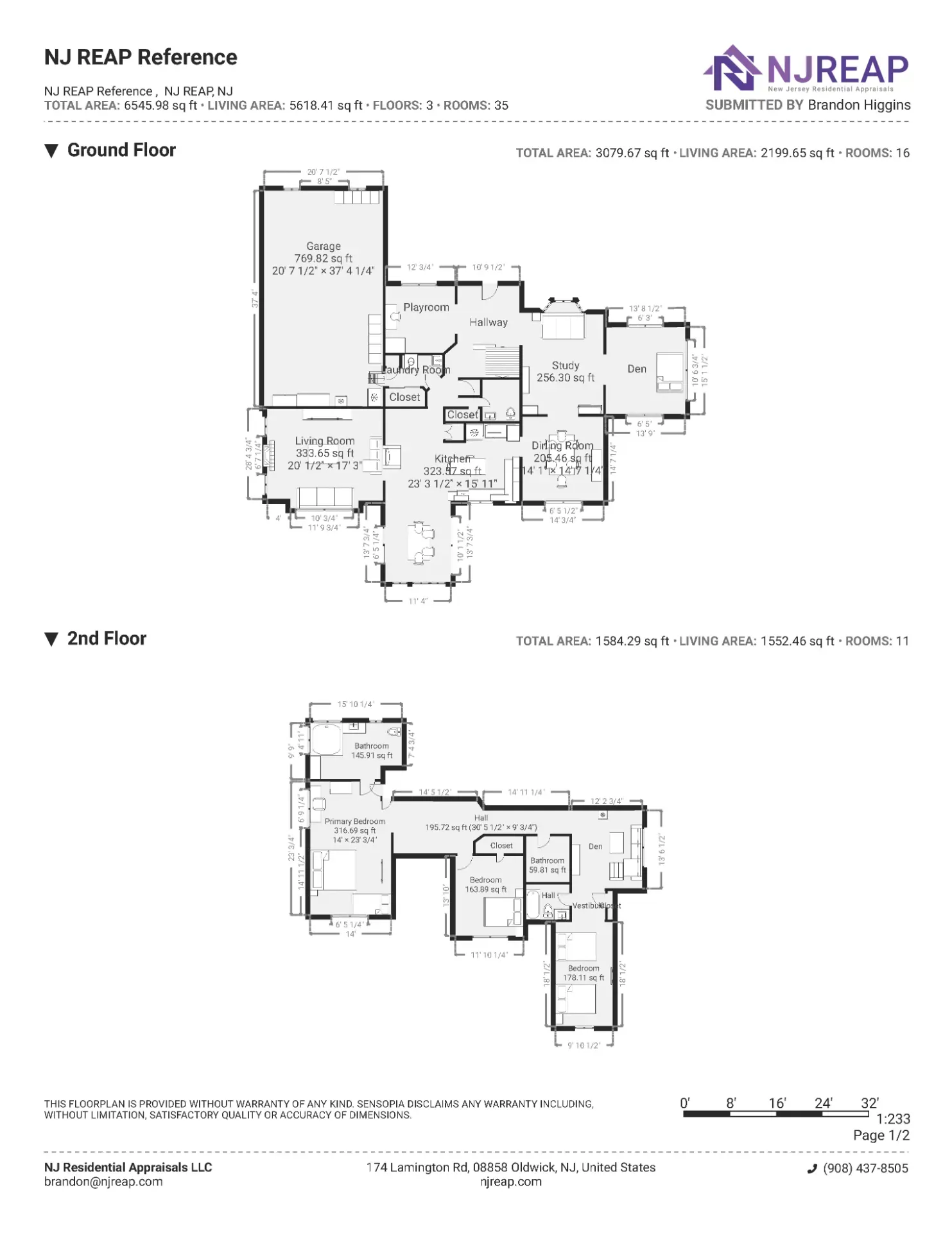
The measurement is taken on site and drawn to scale. Room dimensions and gross living area come from that inspection, not from the tax record, which is often years out of date and occasionally wrong about the footprint entirely.
That matters most where the number is going to be read closely. A living area figure lifted from an assessment card is the first thing a careful reader on the other side will check.
FAQ
Questions people actually ask
Do I need to tidy the house?
Clean helps marginally and clutter does not reduce value, but the honest answer is that neither moves the number much. What does move it is access. A room that cannot be entered has to be treated as an assumption, and assumptions weaken a report. Unlock the basement, the attic, the garage and the utility room.
Should I follow the appraiser around?
You are welcome to, and many people do. It is a reasonable moment to point out improvements that are not obvious, and to ask questions. What it will not do is influence the conclusion, and an appraiser who lets it should worry you rather than reassure you.
Can I tell you what I need the value to be?
You can tell us, and it changes nothing. A fee or a conclusion contingent on a predetermined result is prohibited under USPAP, and a report produced that way is worthless to whoever you need to convince, which is usually the entire reason you commissioned it. What is genuinely useful is telling us what the number needs to do: clear a PMI threshold, support a filing, withstand an opposing expert, because that affects the scope and the level of support, not the conclusion.
What if the value comes in lower than I hoped?
Then it comes in lower, and you have a real number rather than a comfortable one. If you think a specific adjustment or comparable is wrong, say which and why. That is a conversation about the analysis and it is a legitimate one. A disagreement about the bottom line without a disagreement about the reasoning is not.
Who gets a copy?
Whoever the engagement letter names. Ordinarily that is the client, and on written instruction counsel, an accountant, or a servicer. An appraiser cannot hand the report to a third party who was not identified as an intended user, which is a confidentiality obligation rather than an inconvenience.
How long is the appraisal good for?
It states a value as of a specific effective date and it does not expire, but its usefulness does. A current-value report becomes stale as the market moves, and most third parties who rely on one have their own view about how recent it must be, servicers and lenders in particular. A retrospective report to a fixed date, such as a date of death, does not go stale in the same way.
Terms explained in plain English in the glossary.
Next step
Tell us the purpose and the deadline
Those two things determine the effective date, the fee, and the turnaround. If an appraisal is not the right instrument for what you need, you will hear that first.